Overview
Semrush is an industry-standard, all-in-one digital marketing intelligence suite designed to optimize online visibility and discover marketing insights. Originally launched as a basic search engine optimization (SEO) utility, the platform has grown into a comprehensive platform containing over 55 distinct tools. These utilities span search engine optimization, pay-per-click (PPC) advertising, competitive intelligence, content marketing, social media management, and local search tracking.
In response to massive shifts in search engines and user behaviors, Semrush has expanded its core toolkit to address generative engine optimization (GEO) and artificial intelligence (AI) search dynamics. With the launch of the Semrush One subscription, which bundles classic SEO services with modern AI visibility tracking, the software positions itself to help businesses track brand presence not only on standard search engine results pages (SERPs) but also across AI-powered engines like ChatGPT, Gemini, Perplexity, and Google AI Search.
Pros and Cons
| Pros | Cons |
| All-in-One Consolidation: Replaces 4 to 5 separate software applications by packing SEO, PPC, social media, content, and local listings into a single interface. | High Starting Cost: The entry price point is significantly higher than standalone keyword research or content optimization utilities. |
| Generative AI Search Tracking: The newer AI Visibility Toolkit allows users to actively monitor brand mentions and sentiment inside AI search engine citations. | Steep Learning Curve: The massive volume of sub-tools, technical reports, and metrics can overwhelm beginners or non-technical business owners. |
| Unrivaled Keyword and Backlink Databases: Houses over 27.8 billion keywords and an immense index of over 51 trillion backlinks for granular research. | Restrictive Seat Limitations: Base subscription plans only allow for one single user login, requiring high monthly add-on fees for extra team members. |
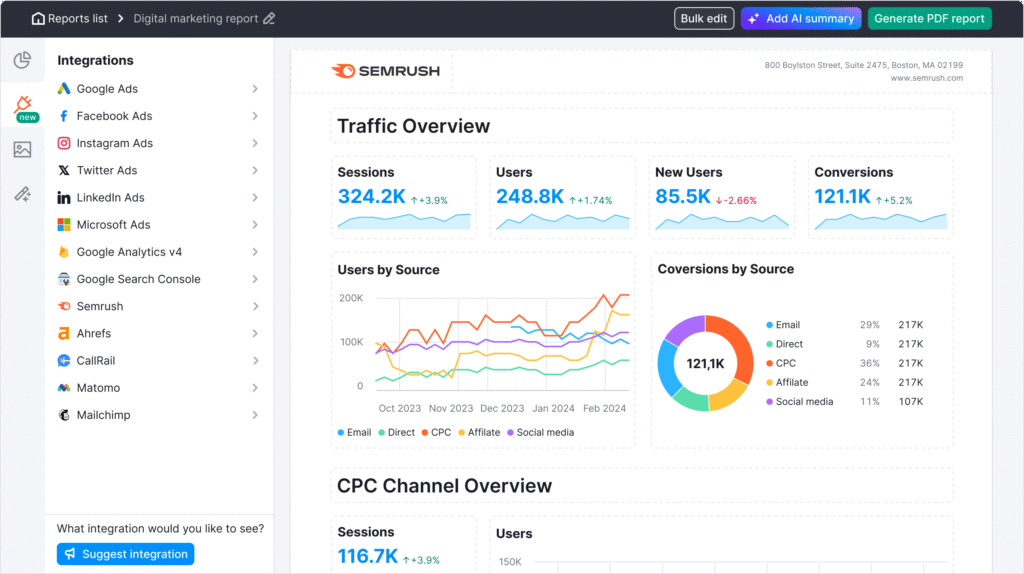
| Excellent Automated Client Reporting: Features high-quality white-label PDF generation and native integrations with Looker Studio for agencies. | Fragmented Add-on Ecosystem: Advanced competitive data, listing management, and specific local SEO tools require paying extra monthly fees. |
Key Features
1. Keyword Magic Tool and Advanced Research
The Keyword Magic Tool remains the absolute gold standard for digital search planning. Bolstered by a database containing over 27 billion terms across 142 countries, it enables marketers to input a single seed keyword and generate thousands of organized variations.
Users can filter results by search volume, keyword difficulty, cost-per-click (CPC) rates, and distinct user intent categories (informational, navigational, commercial, and transactional). The tool also features a specialized Prompt Research mode, showing how consumers phrase complex questions inside generative AI platforms.
2. Competitive Intelligence and Keyword Gap Tools
Semrush excels at dissecting competitor footprints. The Domain Overview and Organic Research modules show exact organic traffic trends, paid ad budgets, and highest-performing subpages for any URL.
Additionally, the Keyword Gap and Backlink Gap features allow small businesses to compare up to five competitor domains side-by-side. The system highlights precise intersection areas where competitors are ranking or acquiring links, but the user is not, showing immediately actionable content opportunities.
3. AI Visibility Toolkit and GEO Tracking
To meet the shifting demands of modern search, the platform features a specialized AI Visibility tracking suite. This tool monitors how often a brand or product is cited in answers generated by major AI search platforms like ChatGPT, Google AI search, and Perplexity.
It keeps tabs on custom prompts to map user sentiments, measures brand share of voice inside artificial intelligence overviews, and tracks whether your core articles are serving as primary data sources for automated answers.
4. Technical Site Audit Engine
The Site Audit tool crawls target domains to analyze overall site health against more than 140 distinct technical and SEO checkpoints. It categorizes discoveries into clear errors, warnings, and notices.
The audit highlights security issues (HTTPS certificates), slow page speeds, duplicate meta tags, broken link networks, and Core Web Vitals performance. It also integrates directly with Google Search Console, so developers can fix prioritized technical errors directly.
5. Content Marketing Toolkit and Writing Assistant
The Content Marketing module assists writers at every stage of the creation pipeline. The Topic Research tool generates clusters of popular subtopics and questions surrounding a target theme.
Once written, the SEO Writing Assistant analyzes the text in real time. It scores readability, tone of voice, original plagiarism levels, and keyword optimization depth directly inside a built-in document editor or via a handy WordPress plugin.
6. Local SEO and Listing Management
For brick-and-mortar storefronts, Semrush automates citation syncs across more than 70 top digital directories, including Google Business Profile, Apple Maps, Yelp, and Facebook.
The Local SEO bundle allows users to respond to customer reviews from a central platform dashboard. It also features a localized Map Rank Tracker, showing how business rankings move on search maps within precise zip codes and blocks.
User Experience
Semrush consolidates an immense amount of complex data into a highly organized navigation hierarchy. A persistent left-side navigation bar splits the platform into logical workspaces: SEO, Local, Advertising, Social Media, Content Marketing, and Trends. Each workspace is clearly divided into research tools and project-specific trackers.
The primary dashboard uses visually intuitive charts, graphs, and percentage health scores to simplify complex data points. However, due to the sheer volume of metrics, the user interface can occasionally feel cluttered, with dozens of overlapping tabs.
The learning curve is high, but Semrush mitigates this by placing helpful hover-over definitions on almost every metric label. There are also free courses inside the Semrush Academy to help new users master the interface quickly.
Pricing
Semrush offers classic SEO subscriptions alongside the unified “Semrush One” bundles, which add AI Visibility features. Paying annually lowers the total monthly cost.
SEO Classic Plans
| Plan | Monthly Price | Annual Price | Target Audience | Key Features & Limits |
| Pro | $139.95 | $117.33 / month | Freelancers, startups, in-house marketers | Track 500 keywords, manage 5 projects, run 10,000 results per report, standard site audits (100,000 pages). |
| Guru | $249.95 | $208.33 / month | Growing agencies, medium businesses | Track 1,500 keywords, manage 15 projects, access historical data, unlock Content Marketing Toolkit, Looker Studio integration. |
| Business | $499.95 | $416.66 / month | Large marketing agencies, enterprises | Track 5,000 keywords, manage 40 projects, white-label PDF reports, API access, highest search query limits. |
Semrush One Plans (Bundled SEO + AI Visibility)
- Starter: $199/month (Or $165.17/month billed annually). Supports 5 project sites, 500 tracked keywords, and 50 custom AI prompt queries.
- Pro+: $299/month (Or $248.17/month billed annually). Built for growing marketing teams needing advanced keyword tracking alongside AI search visibility reports.
- Advanced: $549/month (Or $455.67/month billed annually). Designed for larger organizations tracking up to 40 domains with up to 200 custom prompts.
Key Optional Add-Ons (Billed Monthly)
- Extra User Seats: +$45 on Pro, +$80 on Guru, +$100 on Business.
- AI Visibility Toolkit (Standalone): +$99 per month per domain.
- Trends Module (Market Explorer & Traffic Analytics): +$289 per month.
- Local SEO Listing Management: +$30 to $60 per location.
- Social Media Management Toolkit: +$20 per month.
Integrations
Semrush acts as a central hub, connecting with the primary web master platforms and workspace tools used by marketers:
- Google Search Console & Google Analytics: Synchronizes real-time site impressions, click-through rates, and conversion behaviors with organic keyword positions.
- Looker Studio (formerly Google Data Studio): Standard on Guru and Business plans, this allows agencies to build dynamic, automated dashboards for clients.
- WordPress: Connects the SEO Writing Assistant directly to your blog layout screens to optimize text drafts before publishing.
- Trello & Monday.com: Direct exports of Site Audit task issues directly to task management boards to streamline development queues.
- Social Channels: Direct connections to Facebook, Instagram, LinkedIn, Pinterest, and TikTok for unified analytics and scheduling.
Security and Privacy
Semrush maintains secure data privacy policies across its entire tool catalog. The platform operates on certified cloud network architectures, leveraging standard SSL/TLS encryption for all data transit and database connections. User payment credentials are fully encrypted using secure PCI-DSS standards.
Furthermore, any proprietary integration tokens (such as read/write permissions for Google Search Console, Google Analytics, or Looker Studio) are processed through secure OAuth authorization. Semrush holds read-only access to user analytics, ensuring that sensitive internal company traffic or conversion metrics are never shared with external competitors or used in public marketing indexes.
Who Should Use Semrush?
Freelancers
For independent SEO experts, designers, and writers, Semrush is an all-in-one workspace for client work. It provides immediate market data to win pitches, handles keyword research, and generates automated, professional PDF reports to prove work value to clients.
Marketers
Marketers at growing companies can use the platform to orchestrate campaigns across multiple channels. From analyzing competitor PPC budgets to finding relevant keywords, scheduling social posts, and optimizing on-page copy, it provides a unified hub for daily campaigns.
Startups and Small Businesses
Startups looking to grow online can find low-competition organic niches, fix technical bugs on their sites, and track brand visibility on Google and AI search engines. This helps them compete with larger competitors without wasting budget on trial-and-error advertising.
Alternatives
Ahrefs
Ahrefs is Semrush’s primary competitor and is widely praised for its incredibly fast backlink crawler and backlink database. While Ahrefs is superb for link-building campaigns, Semrush provides a more well-rounded suite of tools, including built-in PPC data, local listings management, and social scheduling.
Moz Pro
Moz Pro is a user-friendly, beginner-friendly SEO suite known for metrics like Domain Authority (DA) and Page Authority (PA). It is highly accessible for non-technical users, but it lacks the advanced competitor research and multi-channel marketing tools found in Semrush.
SE Ranking
SE Ranking is a budget-friendly alternative that is highly popular with small businesses and freelancers. It offers excellent core rank tracking, keyword research, and site auditing at a fraction of the cost of Semrush, though its database size and advanced competitor data are smaller.
Final Verdict
Tool Cento Rating: 9.1 / 10
Semrush remains one of the most powerful and comprehensive marketing intelligence suites on the market. By adding AI and Generative Engine Optimization (GEO) tracking through Semrush One, it has adapted to how search is changing. It has solid SEO, competitive research, site auditing, and PPC tools, making it highly valuable for serious marketers.
However, the platform is not without drawbacks. The high entry pricing, combined with strict limits on user logins and add-on costs, can stretch the budget of a freelancer or very small business. But if you want a single, enterprise-grade platform to monitor your digital marketing and search visibility, Semrush is a highly secure, reliable, and powerful investment.
FAQ
1. What is the cheapest paid plan on Semrush?
The cheapest option is the SEO Classic Pro plan, which costs $139.95 per month, or $117.33 per month when billed annually.
2. What is Semrush One?
Semrush One is a subscription bundle launched in late 2025 that combines standard SEO tools with the AI Visibility Toolkit to track search rankings on ChatGPT and other AI engines.
3. Can I track keyword rankings inside AI search engines like ChatGPT?
Yes. With the AI Visibility Toolkit or the Semrush One plans, you can monitor brand citations, mentions, and sentiment across popular AI search platforms.
4. Does Semrush offer a free trial?
Yes. Semrush offers a limited free trial (usually 7 days on classic plans, or up to 14 days on Semrush One Starter and Pro+) when you sign up with a credit card.
5. Can multiple team members use a single Semrush login?
No. Sharing account credentials violates Semrush’s terms of use and can trigger security lockouts. To add teammates, you must pay for additional user seats.
6. Is my site audit data visible to competitors?
No. Your specific site audits, keyword lists, and integration data (like Google Search Console) are strictly private and secured within your account.
7. How often does Semrush update its ranking database?
Semrush updates its active keyword rankings, search volumes, and backlink metrics daily to provide real-time competitive insights.
8. What is the difference between Semrush and Ahrefs?
Semrush has more comprehensive tools for PPC, local SEO, and social media scheduling. Ahrefs is highly favored by SEOs for backlink analysis and user interface simplicity.
9. Can I export my Semrush reports into PDF formats?
Yes. Users can generate, customize, schedule, and download PDF reports. Advanced plans also support white-label PDFs that display your own agency branding.