
Overview
Lovable (lovable.dev) is an AI-powered full-stack development assistant that translates natural language prompts into clean, functional web applications. Developed by the team behind GPT Engineer, the platform has emerged as a prominent player in the generative software space.
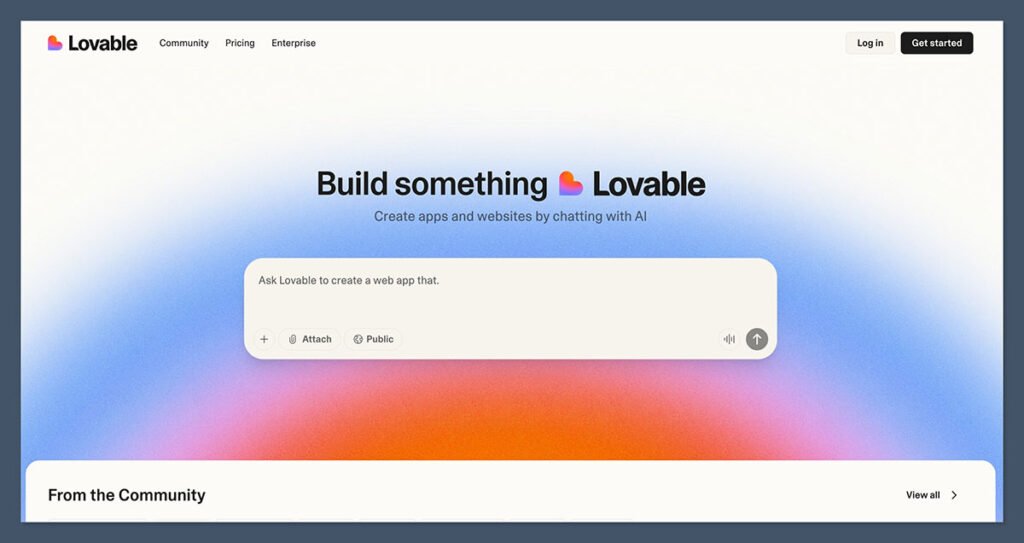
Unlike traditional low-code or no-code tools that lock users into proprietary visual drag-and-drop builders, Lovable generates standard React, TypeScript, and Tailwind CSS code. It runs directly inside a browser-based integrated development environment (IDE), rendering previews in real time and allowing users to publish web apps with a single click. By coupling generative AI with structured database integrations, it aims to eliminate the friction between concept and deployment.
Pros and Cons
| Pros | Cons |
| Clean Code Generation: Generates readable, modular React, TypeScript, and Tailwind CSS code rather than proprietary formats. | Credit Consumption Rates: Complex prompts, multi-step debugging, and image-to-code conversions consume credits rapidly. |
| Seamless Supabase Integration: One-click connection to Supabase simplifies database setups, user authentication, and row-level security. | Backend Limitations: While frontend and basic database logic are strong, heavy custom server-side processing is difficult to implement. |
| Visual Element Selection: The “Select & Edit” feature lets users click specific UI elements and prompt changes locally. | Vendor Lock-in Risk: Exporting code requires development skills to maintain, host, and run independently outside Lovable. |
| Direct GitHub Sync: Automatic commits to GitHub repositories enable easy handoffs and support advanced development workflows. | Scale Cost Volatility: Combining subscription fees with usage-based cloud and AI run-time costs can make scaling expensive. |
Key Features
1. Natural Language App Generation
The core engine of Lovable translates written requirements into functional web pages and interactive application flows. Users begin with a text prompt explaining their idea, and the system drafts the interface, mock data structures, and page routing automatically. It handles complex layout schemes, responsive behaviors across mobile or desktop viewports, and modern UI components out of the box.
2. Select & Edit Visual Selector
To make design and layout updates intuitive, Lovable includes a point-and-click editor. Users click directly on any element in the live preview panel (such as a navigation bar, card, form field, or button) to highlight it. Once selected, users write a specific instruction to update just that targeted section, preventing the AI from rewriting unaffected parts of the application.
3. Native Supabase Database Integration
For full-stack capability, Lovable connects directly with Supabase. The platform automatically generates the PostgreSQL schema, configures database tables, defines foreign keys, and implements secure Row-Level Security (RLS) policies based on user descriptions. It also scaffolds user login, registration, and session management systems using Supabase Auth.
4. Direct GitHub Synchronization
Every change made within the browser workspace can be synced to a dedicated GitHub repository. When the AI writes or modifies code, it packages those modifications into organized Git commits. This keeps the codebase aligned, supports branching workflows, and lets developers pull the clean React code locally to continue working in their own IDEs.
5. Multi-Mode Generation (Plan & Default)
Lovable provides distinct generation modes to optimize credit usage. Default Mode processes simple, localized tasks with variable credit costs based on complexity. Plan Mode charges exactly one credit per message but causes the AI engine to lay out a detailed multi-step implementation plan before writing any code. This planning phase reduces coding errors on broad or complex feature updates.
User Experience
Lovable organizes its workspace into a clean, dual-panel layout. The left side functions as a conversational sidebar for chatting with the AI engineer, while the right side displays a live, interactive preview of the application. The system updates the preview within seconds of processing a prompt, making iterations feel fast and continuous.
Because the interface generates standard web layouts, the learning curve is exceptionally low for non-technical users. Marketers and startup founders can comfortably request visual edits using the visual selector. For advanced users, the workspace offers a built-in code editor that exposes the underlying React files. This hybrid design allows users to write custom code alongside the AI-generated blocks when needed.
Pricing
Lovable utilizes a credit-based subscription model. A credit is consumed when building apps, running deployed apps (Cloud credits), or using integrated AI features within finished applications.
| Plan | Monthly Price | Annual Price | Monthly Credits | Key Target Audience |
| Free | $0 | $0 | 5 daily credits (Up to 30/mo) | Casual hobbyists, absolute beginners |
| Pro | $25 | $20 / month | 100 base + 5 daily (Up to 150/mo) | Solo freelancers, indie hackers |
| Business | $50 | $40 / month | 100 base + team workspace | Small startups, marketing agencies |
| Enterprise | Custom | Custom | Volume-based | Large organizations with compliance needs |
Note: On-demand credit top-ups are available for paid subscribers starting at $15 for 50 credits on the Pro plan.
Integrations
To remain lightweight, Lovable relies on key modern cloud services to power its ecosystem. Rather than offering hundreds of minor connectors, it concentrates on high-impact developer tool integrations:
- GitHub: Synchronizes codebases instantly, allowing for continuous delivery pipelines and local code access.
- Supabase: Serves as the primary database, authentication provider, and real-time backend engine.
- Stripe: Handled through generated checkout scripts and client-side integrations for processing payments.
- Resend: Used to configure custom transactional transactional email delivery (e.g., password resets, welcome emails).
Security and Privacy
Lovable maintains standard enterprise-grade data security protocols. Code and application configurations are stored securely on modern cloud infrastructure.
For business-critical operations, data privacy policies vary by subscription tier. The Free and Pro tiers may utilize prompt history to improve future AI model outputs. However, the Business and Enterprise tiers offer data opt-out features, ensuring that proprietary source code, application architectures, and database structures are never used to train public LLM models.
Who Should Use Lovable?
Freelancers
Freelancers can leverage Lovable to build functional frontend prototypes and simple client MVPs (Minimum Viable Products) in hours instead of weeks. The clean React/Tailwind code output makes it easy to pass project deliverables directly to a client’s development team.
Marketers
Marketers can rapidly launch high-quality landing pages, custom lead-capture forms, interactive pricing calculators, and simple marketing tools without waiting for internal development resources.
Startups and Small Businesses
Early-stage startups can utilize the tool to validate ideas, build functional products for early beta testers, and pitch to investors without hiring an expensive engineering team.
Alternatives
Bolt.new
Bolt.new is an in-browser AI development platform that can generate full-stack Node.js environments. While Lovable specializes in building clean, scalable React client applications with Supabase, Bolt.new excels at running diverse backend frameworks and npm libraries directly in the browser.
Replit Agent
Replit Agent provides a highly developer-centric AI building experience integrated with Replit’s cloud hosting platform. Replit Agent is excellent for python-based backends and complex system architectures, whereas Lovable offers a cleaner visual UI builder and superior drag-and-click edit capabilities.
Bubble
Bubble is a traditional, powerful no-code visual programming platform. It handles complex database workflows and large-scale applications well, but it utilizes a highly proprietary system. Lovable stands out by generating clean, standard, exportable React code with no platform lock-in.
Final Verdict
Tool Cento Rating: 8.4 / 10
Lovable represents a major step forward in AI-driven web development. By outputting production-grade React, TypeScript, and Tailwind CSS code instead of proprietary files, it bridges the gap between no-code speed and standard engineering practices.
While its credit system requires careful planning—and heavy server-side processing still demands external tools like Supabase—it remains an exceptionally fast path for building functional web applications. It is an excellent choice for freelancers, marketers, and startup founders who need to launch clean, modern web apps quickly.
FAQ
1. Do I need to know how to code to use Lovable?
No. You can build, edit, and publish complete web applications using only natural language prompts and the visual selector tool.
2. Can I export my code out of Lovable?
Yes. You can export the raw React, TypeScript, and Tailwind CSS code or sync it automatically to a private GitHub repository.
3. What is the difference between Daily and Monthly credits?
Daily credits (5 per day) do not roll over and must be used on that day. Monthly credits roll over for one billing cycle on paid plans.
4. Does Lovable host my live applications?
Yes. Lovable includes a global cloud hosting allowance (Cloud credits) for publishing your projects with a single click.
5. Can I use my own custom domain?
Yes. Custom domain mapping is supported on all paid subscriptions, starting with the Pro plan.
6. What database does Lovable support?
Lovable integrates natively with Supabase to provide fully functional PostgreSQL databases, user auth, and storage.
7. Is my data used to train AI models?
If you are on the Business or Enterprise tiers, you can opt out of data sharing to keep your code and prompts private.
8. Is Lovable suitable for large-scale production apps?
It is ideal for MVPs, business utilities, and frontends. Extremely complex backends or data-heavy platforms may still need custom developer resources.